Munich / Hamburg / Mannheim, September 3, 2026
Telefónica Deutschland, E.ON Grid Solutions, Westnetz, and Power Plus Communications (PPC) have successfully tested 5G RedCap as a new mobile communication technology for smart meter gateways. For this purpose, a 5G RedCap-enabled smart meter gateway from PPC was connected to the meter operator’s backend systems via Telefónica Deutschland’s 700-MHz network.
This allowed the partners to simulate the entire communication chain under real-world conditions—from the smart meter gateway through the cellular network to the meter operator’s systems. The tests demonstrate the potential of 5G RedCap for a long-term, reliable, and cost-effective cellular connection for smart metering systems.
Successful End-to-End Test via 5G RedCap
As part of the joint project, PPC integrated a 5G RedCap-enabled cellular solution into a smart meter gateway. The prototype devices were installed in the infrastructure of E.ON’s metering point operator Westnetz and connected to the backend systems via Telefónica Deutschland’s cellular network.
5G RedCap is used, among other things, in the 700-MHz band. The low cellular frequency offers long range and good building penetration. These are important advantages for smart meter gateways, as the devices are often installed in basements or other locations that pose challenges for radio signal transmission.
5G RedCap as a Pathway to the Next Generation of Mobile Communications
Mobile communications already play a central role in connecting smart meter gateways. Since smart metering systems remain in use for many years, a reliable, cost-effective, and future-proof communication solution is particularly important.
5G RedCap (“Reduced Capability”) is a variant of the 5G standard optimized for applications with moderate data rate requirements. Compared to standard 5G, RedCap offers reduced complexity and lower power consumption while still providing sufficient performance reserves for advanced applications in smart meter gateways.
This makes 5G RedCap an attractive technological option for the next generation of WAN communication in smart metering systems and paves the way for a gradual transition from today’s LTE-based solutions to the 5G world.
Mallik Rao, Chief Operating Officer at Telefónica Deutschland, says:
“With its 5G network, Telefónica Deutschland provides a key digital infrastructure for the digital control of modern power grids. With 5G RedCap, the company tailors the infrastructure specifically to the needs of the energy industry. Our goal is to give companies access to the digital technologies they need for their transformation—reliable, scalable, and future-proof. The technology enables stable and energy-efficient networking of large numbers of smart meter gateways. This provides energy providers with investment security and allows them to gradually transition their metering systems to a modern 5G infrastructure.”
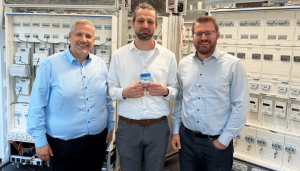
Janosch Wagner, CTO of Power Plus Communications AG, adds:
“Smart meter gateways are operated in the field for many years. That’s why meter operators need communication technologies that combine high availability with a long-term perspective. 5G RedCap is particularly interesting to us because the technology combines the requirements of smart metering systems with the future-proof capabilities of 5G. The combination with the 700-MHz band also provides excellent conditions for ensuring gateway connectivity in challenging installation locations. The successful end-to-end tests demonstrate that RedCap is a promising option for the next generation of WAN communication for smart meter gateways.”
Benjamin Jambor, CEO of E.ON Grid Solutions, says:
“With 5G RedCap, we are laying an important foundation for the next phase of smart grid expansion. The technology enables us to connect smart meter gateways even more reliably and efficiently—even under challenging field conditions. The joint tests show that 5G RedCap is a future-proof option for the continued rollout of smart metering systems and offers energy providers additional flexibility in choosing their communication infrastructure.”
Next Step: Incorporating the Results into Product Development
Once the initial prototype tests are complete, the partners will conduct a detailed analysis of the results. The focus will be particularly on findings regarding network availability, accessibility at various installation sites, and the interaction between the smart meter gateway, the cellular network, and the backend infrastructure.
The results will be incorporated into the further product and solution development of the participating companies.