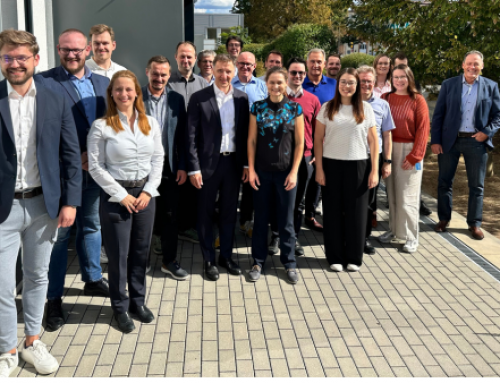
Through the IKTres innovation project, launched in May, PPC is working with partners from the research and energy sectors to develop new solutions aimed at making information and communication technology (ICT) in smart distribution grids more resilient to disruptions and outages. The focus is on the infrastructure of smart metering systems (iMSys), the network management system (NMS), and the digital grid twin.
Under the leadership of the DLR Institute for Networked Energy Systems, PPC, the OFFIS Institute for Computer Science, Mainzer Netze GmbH, GridData GmbH, and the elenia Institute at the Technical University of Braunschweig are working together to achieve the project’s goals. Last week, the consortium met for the first time at Mainzer Netze to coordinate their common goals, key areas of focus, and next steps.
The innovation project focuses on developing preventive and corrective measures to increase the resilience of the iMSys infrastructure. To this end, the project partners are developing and testing methods for detecting, diagnosing, and compensating for ICT disruptions. These are to be integrated, among other things, into the iMSys infrastructure and digital grid twins to enable resilient grid operation with as few restrictions as possible for consumers, generators, and prosumers in the low-voltage grid.
A key focus of PPC is the prototypical further development of the NMS. This includes new parameters and functions for improved fault detection, as well as the further development of mechanisms to optimize WAN communication in the SMGW.
The approaches developed will then be evaluated through simulations as well as laboratory and field tests. The goal is to assess how effective the measures are at the prosumer, grid, and system levels and how they perform under realistic conditions.
The results will also be used to develop concrete recommendations for grid and metering point operators, prosumers, and standardization bodies. In this way, IKTres is making an important contribution to strengthening supply security and reliably supporting the use of decentralized flexibility.
The project is funded by the Federal Ministry for Economic Affairs and Energy.