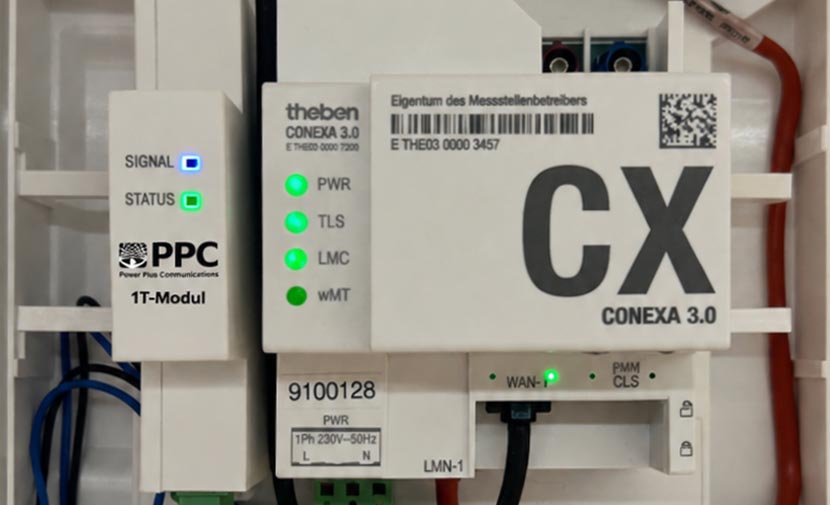
The framework agreement covers various communication requirements for the smart meter rollout. The agreed-upon portfolio includes PPC smart meter gateways in the LTE, LTE450, Ethernet, and VPN SMGW variants. Primary and competitive metering operators can thus select a suitable WAN connection depending on the installation location, existing infrastructure, and use case. In addition, EEBUS relay converters and CLS adapters are available for various control and application scenarios.
In addition, HED customers can utilize services provided by PPC: verification of SMGW configuration data, SIM card management, the FOX logistics and retrieval service, and the VPN service. FOX enables digital management of gateway inventories and the delivery of devices to deployment sites as needed. HED can integrate these services provided by PPC—depending on the customer’s needs—with asset procurement, long-term device provisioning, and other modular services. This reduces interfaces and creates opportunities to lower process overhead and rollout costs.
PPC is also continuing to develop its smart meter gateway solutions with an eye toward future BSI requirements—in particular, Protection Profile 2.0 (PP 2.0) and TR-03109-1 Version 2.0. With the SMGWplus, control commands can be transmitted via a digital interface to energy management systems or controllable equipment. Depending on the installation scenario, this can reduce the need for additional control hardware in the meter cabinet and minimize installation effort.
Technology and Processes Designed Together
“A successful rollout requires the reliable interplay of device availability, clear processes, and efficient communication channels. PPC contributes technology and proven services to this effort. With Horizon Energy Deutschland, we combine these building blocks into an ‘Asset-as-a-Service’ offering that makes it easier for metering point operators to scale economically,” said Ingo Schönberg, CEO of PPC.“After all, when investment, device provisioning, connectivity, and rollout services work together seamlessly, the effort and costs for metering point operators can be reduced.”
Greater Cost-Effectiveness Through Integrated Asset-as-a-Service
The partnership with PPC is a key component of HED’s technology-neutral “Asset-as-a-Service” approach. The company works with its customers to analyze the economic and technical requirements of the rollout, identifies suitable assets, handles their procurement and financing, and retains them in its own portfolio over the long term. The service model also includes agreed-upon functional validation as well as inventory, warranty, and lifecycle management. Depending on needs, additional components such as logistics, installation, field service, and IT or MSB platform services can be added through qualified partners. The combination of capital, technology, and services opens up concrete opportunities to reduce the total cost per metering point and sustainably improve the cost-effectiveness of the rollout. The scope of services and operational tasks remain flexible; the metering point operator retains its market role and customer relationship.
“Our goal is to improve the cost-effectiveness of the entire smart meter rollout—not just to facilitate financing. As an Asset-as-a-Service partner, we combine predictable asset costs with technology-neutral procurement, long-term asset and risk management, and modular services. In this way, we help meter operators reduce capital tied up in assets, process overhead, and total costs per meter. PPC complements this model with high-performance technology and tailored services. Our customers retain the freedom to choose their technology, market role, and operational value creation,” says Emil Bruusgaard, Managing Director of Horizon Energy Deutschland GmbH.