

inexogy and PPC: Practice Trumps Theory—Lessons Learned from the Control System Rollout
Control systems in the smart grid aren’t just an issue for 2027—they should already be making their way to end users today. The competitive metering point operator inexogy shares this view. As one of the first competitive metering point operators (wMSBs), they took the leap from a pilot project to a full-scale control rollout and demonstrated what really matters in this context.
inexogy specializes in smart metering systems and is part of the Techem Group. The company operates smart meters nationwide and has already installed over 1,000 control devices in the field. This makes inexogy one of the few companies that already successfully operates the entire control chain—from the backend to the controllable consumption device—in practice.
“I would say we are no longer just in the theoretical phase, but in the practical one—in the transition to the control system rollout. We have installed over 1,000 control units, are operating them with various HEMS systems, and have successfully closed the entire control chain.”
Nikolas Koch, Head of the Technology & SMGW Department at inexogy

Facts, Figures, and Data on the Control System Rollout at inexogy
The impressive successes inexogy has already achieved in the tax rollout—and what the next steps look like:
- >1,000 CLS control units installed and operational
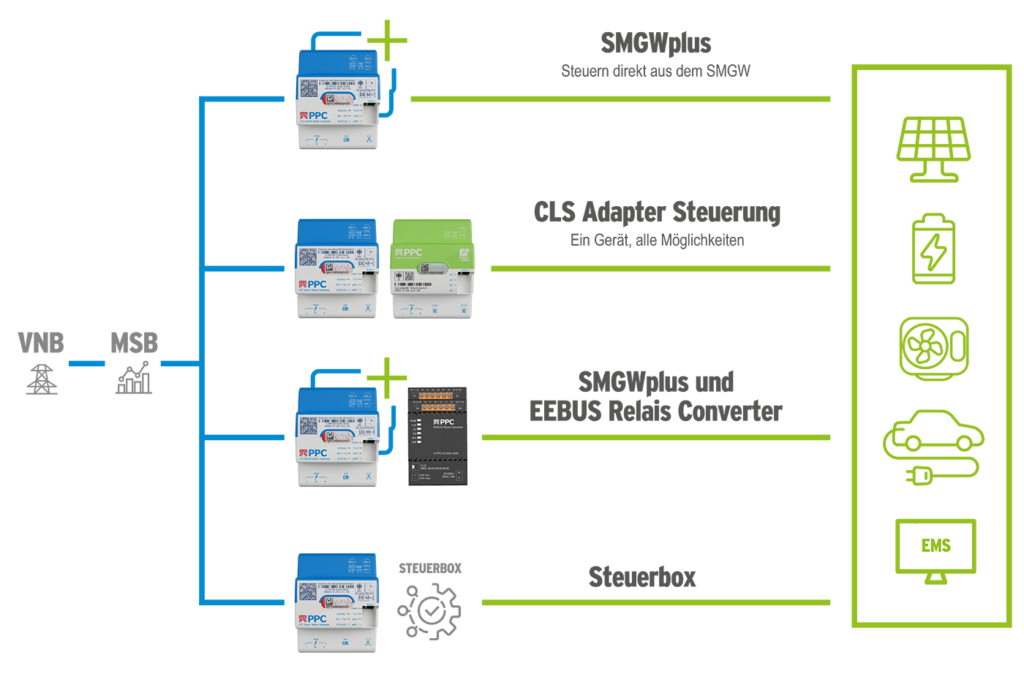
- Interoperability and integration of the CLS adapter control system successfully achieved with all SMGW manufacturers
- Several HEMS successfully connected and controlled in the field
- Complete control chain from the backend to the control device successfully implemented
- Short term: Introduction of the SHIP pairing service for automated SKI exchange without manual steps
- Medium term: EEBUS certification as a mandatory requirement for HEMS during rollout
Lessons from the Field—What All Competitive MSBs Should Keep in Mind During Rollout:
- Control tests throughout the entire chain are essential—many errors only become apparent in practice
- Transparency behind the CLS adapter control is incomplete: Whether a HEMS can still be actively controlled is currently only apparent after a control test
- The commissioning of the SKI actively involves customers and thus creates additional work, which can be eliminated through SHIP pairing
- Clear standards for customer networks and EMS are a prerequisite for stable operation
- Committee work pays off: FNN, the EEBus Initiative, and BSI are active contributors to the development of processes and standards
The control system works—here are the findings
As the project transitions from the pilot phase to the full-scale rollout, the areas where all industry participants need to find common ground are becoming apparent.
For inexogy, three topics are central:
- Operational transparency
- the complexity of commissioning
- the need for uniform standards—particularly regarding EEBUS and EEBUS SHIP pairing
After all, anyone trying to look “behind” the CLS adapter today still sees too little in the backend: It’s not immediately apparent during operation whether a HEMS (Home Energy Management System) is actively paired with the control unit. Connection status, serial numbers, diagnostic data—none of this is yet uniformly formatted and available. Only after a control test can it be determined whether the control system is functioning properly. This is a situation that needs to change as soon as possible. The solution lies in standardized diagnostic options, such as the HEMS connection status via CLS-EEDI.
Similar hurdles still exist during the commissioning process itself. Currently, in many places, active customer involvement is required. Customers must provide SKI tokens and the EMS and, if necessary, carry out trust processes. This takes time to prepare, requires specialized training for service personnel, and slows down installation processes. The solution lies in the EEBUS SHIP Pairing Service. This service automates the SKI exchange and eliminates the need for manual steps. In the medium term, EEBUS certification is also set to become a mandatory requirement for all HEMS systems during the rollout. This would enable true plug-and-play functionality throughout the entire control chain.
Here’s another insight inexogy is happy to share from its own control system rollout: control tests along the entire chain are indispensable. Many error scenarios only become apparent when all components interact—not in a laboratory setting. That’s why inexogy systematically tests new energy management systems—first in the lab, then on-site at the customer’s location—and always with a complete control cycle. It’s an effort that pays off—but it requires a shared understanding among all parties involved.
Articles with content related to control systems


